
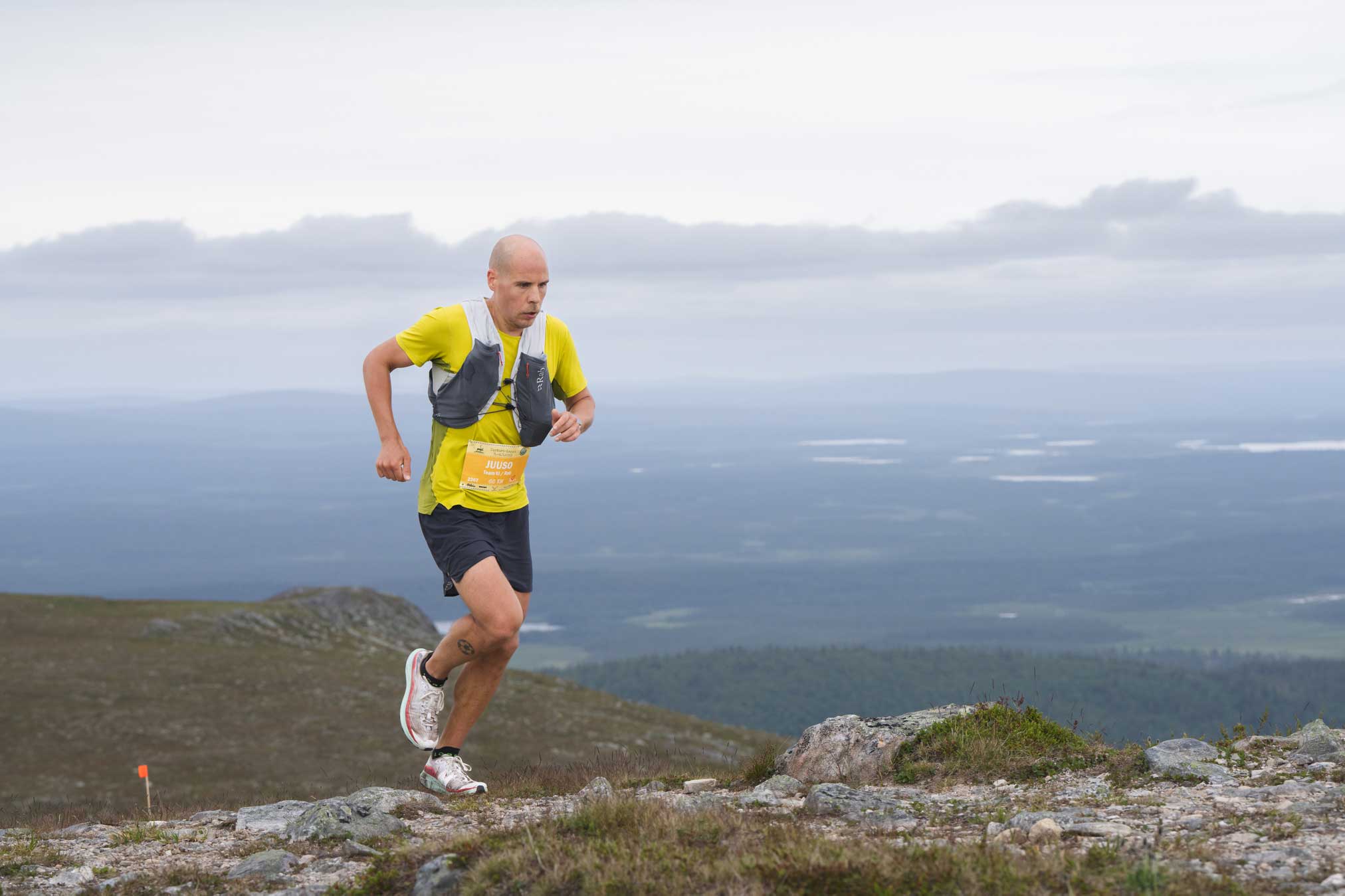
Simpanen and Bengs chase course records despite the heat
This is a machine translation generated by ChatGPT. Original text by Marko Krapu in Finnish.
Heat will take center stage at the long-awaited July classic, NUTS Ylläs Pallas. A few days before the event, forecasts predict nearly 30°C in the national park region.
Due to the extreme temperatures, the organizers have decided to allow runners to bring their own hydration between aid stations. However, national park access restrictions must still be respected.
Additionally, the western end of Lake Kesänkijärvi, which hosts the 15 km aid station, will now offer Nosht sports drink. All runners, regardless of distance, are encouraged to hydrate here before the steep climb up Pirunkuru.
The organizer’s hydration recommendation (1.5 liters) is an absolute minimum. We strongly suggest carrying as much fluid as you can manage.

5 tips for running in the heat
1. There is little to no shade along the race routes. Protect your head with a light-colored cap, apply plenty of sunscreen, and wear light, loose-fitting clothes.
2. Start hydrating before the race. Don’t show up at the start line half-dry. Drink sports drinks and/or beverages with electrolytes.
3. Aid station intervals can be long. Bring more fluids than you normally would. Don’t rush through the stations – take your time to hydrate properly.
4. Adjust your pace to match the conditions. Avoid overheating by not pushing too hard. On the 37 km route, both the Ylläs and Kesänki climbs are physically demanding – and the latter can feel like an oven in the heat.
5. Northern Finland has had a dry summer. Don’t count on all mountain streams having water. If you come across a lake or pond, use it to cool yourself down.
Lintala hopes heat training will help

Elite runners are also concerned about the heat. Followers of Tommi Lintala on social media may have noticed him doing intense treadmill sessions in full clothing earlier this summer — a way to help his body adapt to heat.
“I’m really bad at running in hot conditions. I’m still not particularly strong in the heat, but I hope the training helps at least a little,” he says.
“Even though 37 km may seem short, we’ve seen some serious meltdowns in heat on this route over the years. I’ll try to keep things as steady as possible from start to finish,” Lintala adds.
Lintala is competing in the 37 km race, which is once again part of the Trail Tour Finland series. In May, he finished second in the 83 km at NUTS Karhunkierros.
“After Karhunkierros, I had foot pain for several weeks. But little by little, run by run, I found my rhythm again — and training has felt good for a few weeks now.”
Other top contenders on the 37 km include Ole Antti Halonen, who has shown strong early-season form, Kari Varis, who placed third in the Karhunkierros 55 km, and Johannes Soutukorva.
Erkkilä defends her title

On the women’s side, one favorite clearly stands out: Anna-Stiina Erkkilä is making a strong comeback after a long injury break.
She officially returned to racing a few weeks ago by winning the Rovaniemi Trail Run half marathon in dominant fashion.
“That race was a great test to see how my foot had recovered. It was a huge relief mentally to realize I could run a hard race and my foot handled it just fine.”
Erkkilä has fond memories of Ylläs: last year she blazed through the updated 37 km course with a blazing new record of 2:48:59.
“This race is a great benchmark for my current fitness. It’s nice to have last year’s time for comparison. I hope I can get close to that again. It feels great to be back on the start line at Ylläs.”
Her eyes are already on the trail running World Championships in Spain later this September. She hasn’t yet decided which distance to race, but after Ylläs Pallas, she’ll be one step closer to making that decision.
“After Ylläs I’ll do one mountain race in August, and then head to a training camp in Font-Romeu. I hope the altitude and vertical meters there sharpen my form for the big challenge in the Pyrenees.”
There had been hope for a head-to-head battle between Erkkilä and Pirjo Saukko, but unfortunately Saukko suffered a foot injury at a training camp in Livigno just a week before the race.
“I’m really disappointed, because I was otherwise in good shape. But I probably wouldn’t have beaten Anna-Stiina anyway. I haven’t been able to run much over the winter, spring, or even summer. I’ve done a lot of alternative training, which helped me run in Andorra,” says Saukko, who stunningly won the 100 km race there.
Simpanen prepares for Spartathlon
Hot weather can also be an advantage — especially if you’re training for the 246 km Spartathlon like Juuso Simpanen.

Simpanen, who traditionally trains in the Ylläs Pallas area in July, is running the 160 km this year and has his sights set on a new course record. The current record is 16:28:07, held by Slovakia’s Marian Priadka.
“I’m definitely aiming for the course record, but I won’t be taking huge risks. At Rauhala (87 km), I’ll check where I stand time-wise and decide whether to push the pace.”
In recent months, Simpanen has focused on adapting to hot conditions — a must for the Spartathlon, where even late September temperatures can be brutal.
“We trained for 12 days in Greece with Johanna Antila. I’ve definitely learned a lot — especially how to prepare for heat and how to keep cool during the race.”
“I ran the final 166 km of the Spartathlon route in three parts. Temperatures were over 35°C on those runs, so I got to test cooling strategies, nutrition, hydration — and how it really feels when the Greek sun is beating down on you,” says Simpanen, who’s aiming to win the legendary race.
Other interesting names to watch in the 100-mile field include Karhunkierros winner Alexander Jungarå and last year’s Ylläs Pallas third-place finisher Juho Kunnari. Also in contention: Antti Siren, Jussi Nieminen, and Tuomas Räbinä.
Bengs aims for sub-20 hours

In the women’s 160 km, Eevi Bengs is gunning for the course record held by Irene Päärn (21:49:20).
Just weeks ago, Bengs smashed the course record at Karhunkierros, even beating all the men. Now she’s aiming for a new milestone.
“I’ve never run 100 miles in under 20 hours — it’d be awesome to do it. And in theory, the Ylläs Pallas route is faster than Karhunkierros,” Bengs shares.
Last year she completed the 323 km wilderness adventure at Ylläs Pallas. Back then, she ran much of the course alongside Max Moberg, who just repeated his win in 47.5 hours. Was she tempted to return to the 300+ km again?
“Absolutely! I really struggled with the decision. I chose the shorter race because it fits my season better — but I definitely want to return to the long one in the future.”
“Ylläs Pallas is a special place for me — it was my first ultra, three years ago. And the midnight sun always gives me chills. I hope I’ll have more company on the trail this year than I did at Karhunkierros. Based on the start times, it looks like our route won’t intersect with runners from other distances, so I’ll need to find company within the 160 km field.”
The 160 km is also the second stage of this year’s Ultra Trail Tour Finland.
Aro aims for something other than DNF or DNS
Outside the main distances, the men’s 66 km looks particularly interesting this year.
Three names stand out: Anton Aro, Casper Höglund, and Einari Heinaro.
Heinaro, with an orienteering background, won the 37 km race at Ylläs last year and earned a spot on Finland’s national team for the World Championships. It will be exciting to see how he handles the longer distance.

Aro and Höglund are usually seen on much longer courses, but both have now opted for the Hetta–Pallas route. Aro’s spring season was rough, with illness disrupting several races.
“It’s been a broken season with flu and stress — I haven’t always handled things the best way,” Aro says.
“This 66 km race is more of a prep run ahead of my Chamonix adventure. I want a clean run and hope to get out for a long run again Saturday morning before the family wakes up. And ideally, I’d like something other than DNS or DNF on the results sheet,” he laughs. He even considered doing the 37 km on Saturday after the 66 km.
Just like Aro, Höglund also DNF’d the 100-mile Karhunkierros race. Still serving in the army, he’s been dealing with an Achilles injury and will make a last-minute decision on whether to race.
Other names to watch include Eemil Heiskanen, who won the 100 km at Ylläs three years ago.
Pirkonen returns after a serious injury

The women’s 66 km will see a highly anticipated comeback as Kaisa Pirkonen pins on a bib after many months away.
Last year, Pirkonen won the 100 km at Ylläs and earned a spot on Finland’s national team. But in late December, she suffered a serious injury.
“I badly injured my ankle during training. It was practically hanging by the skin. My planned training camp in the Canary Islands was replaced by an operating room at Kuopio hospital. They screwed and plated my ankle back together. I couldn’t take a single running step for three months. At that point, I thought the World Championships were off the table.”
A long rehab followed: rowing, cross-training, strength work. Then skiing, treadmill runs, and eventually outdoor runs.
“In June, I was able to run technical trails reasonably well. Shoes have been a challenge — the screws still rub a bit.”
“This race really matters to me. It’s a test for the ankle. Physically I feel good, so I just hope it holds up. I’ll be happy if I can race according to my fitness and cross the finish line.”
Over 2,700 runners have signed up for the event — pointing to a new participation record. Last year, 2,131 runners started.
Text:
Marko Krapu